February 4, 2025
Sora Shipped. It's Fine.
Sora Shipped. It's Fine.
The most hyped AI product in history finally launched. Two months later, the most accurate review is the least exciting one.
A year ago, I wrote that Sora was a demo reel, not a product. OpenAI had released those stunning preview videos in February 2024: the woman walking through Tokyo in golden light, the woolly mammoths trudging through snow, the camera sweeping through an impossibly detailed museum. The internet lost its collective mind. Video is solved, they said. Hollywood is over. The creative industry has maybe eighteen months.
I said: let's see the product.
Well. We've seen the product.
The Launch
Sora Turbo went public on December 9, 2024. Within hours, it crashed. The servers buckled under the weight of a million people who'd been waiting a year to try the thing they'd been told would change everything. OpenAI scrambled. Service was spotty for days.
Once the dust settled, here's what shipped: ChatGPT Plus subscribers ($20/month) get 50 video generations per month, at up to 720p and 5 seconds per clip. Pro subscribers ($200/month) get unlimited generations, up to 1080p, up to 20 seconds. The Storyboard feature lets you plan multi-shot sequences. There's a Remix mode for tweaking existing videos.
On paper, this is a real product. It has pricing. It has features. It has a user interface. It's not a research preview or a waitlist or a blog post with cherry-picked examples.
In practice, it's fine.
"Fine" Is Devastating
I need to explain why "fine" is the worst possible verdict for Sora specifically.
If Sora had shipped as a quiet research tool, "fine" would be perfectly acceptable. Most tools are fine. Fine is the baseline. But Sora didn't ship quietly. Sora shipped after twelve months of the most aggressive hype campaign in AI history. Twelve months of curated videos. Twelve months of breathless coverage. Twelve months of "this changes everything."
When you spend a year telling people you're going to change the world, "fine" is a failure.
The generation quality is real. Sora can produce clips that look cinematic. The physics simulation is impressive in spots; water flows convincingly, fabric drapes naturally, light behaves plausibly. When it works, you can see the potential.
But it doesn't always work. Generation times are slow, sometimes several minutes per clip. Quality varies wildly between attempts. The same prompt can produce something beautiful and something broken in consecutive runs. Physics are impressive until they aren't, and you can't predict which way a given generation will go. You can burn through your monthly allocation quickly just trying to get one usable clip.
And those cherry-picked demo videos from February 2024? They were exactly what I said they were: the best-case scenario. The carefully curated highlights of a system that, on average, produces results considerably less impressive than its greatest hits.
The Market Moved On
Here's what happened while OpenAI was perfecting their demo reel.
Kling shipped. Version 1.0 launched in June 2024, and by the time Sora went public, Kling was already on version 1.5 with months of real-world feedback baked in. Runway pushed out Gen-3 Alpha over the summer. Luma Dream Machine launched. Pika iterated through multiple versions. Each of these tools hit the market, gathered user feedback, fixed problems, and improved.
By December 2024, the AI video landscape was no longer the empty field it had been when Sora's demos first dropped. It was a crowded market full of tools that actual users had been stress-testing in actual production for months.
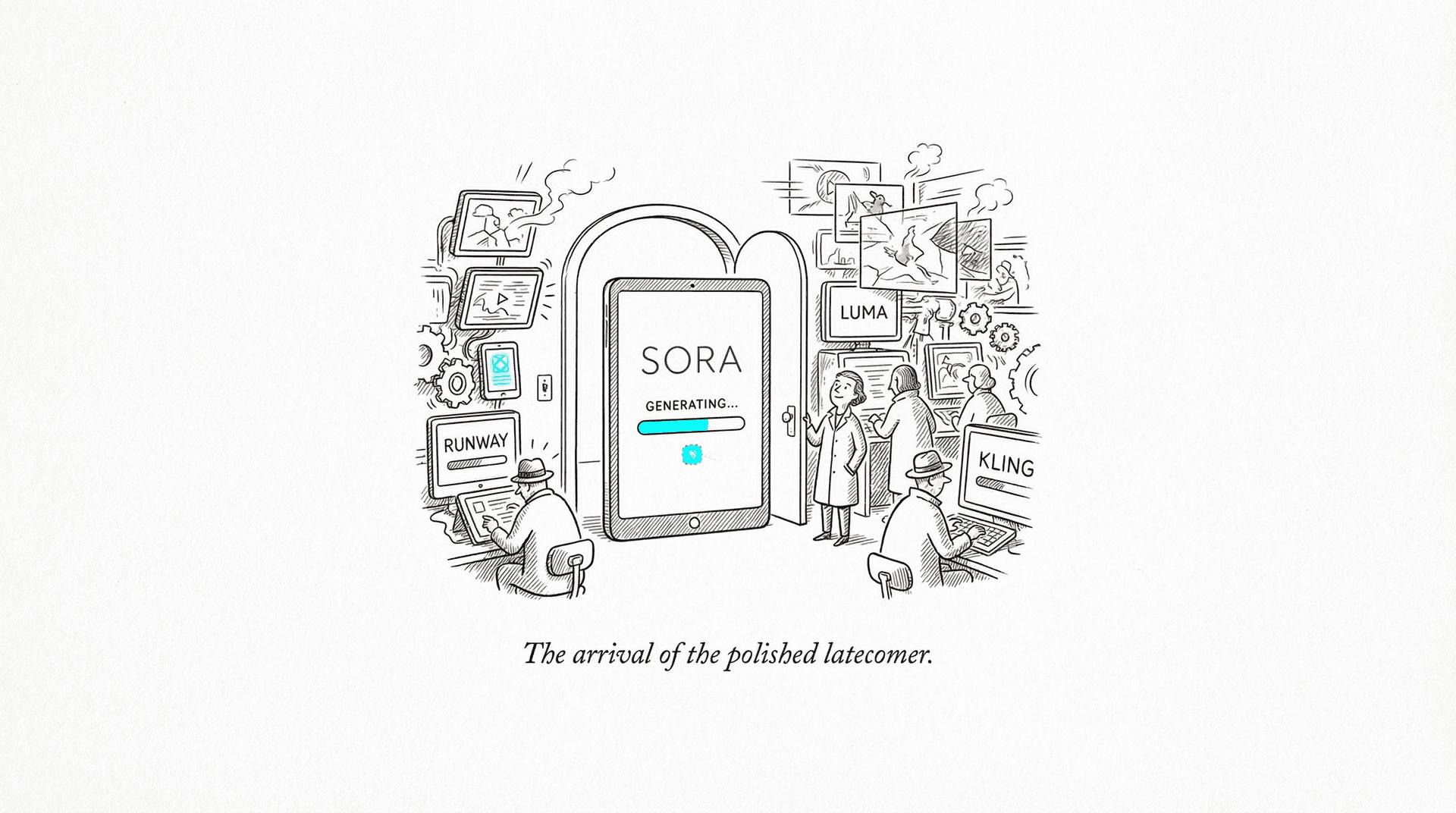
Sora walked into a room and expected applause. The room had already started the meeting without it.
This is the cost of the demo-first strategy. When you announce a product a year before it ships, you don't just set expectations. You give your competitors a roadmap and a head start. Every other AI video company watched those Sora previews and said: that's the bar, and they have no product. Let's ship.
And they did.
I think about this in terms of the old tech industry wisdom about shipping. Reid Hoffman's line about being embarrassed by your first version. The companies that won the AI video space (so far) are the ones that shipped something imperfect, took the criticism, and fixed it. Kling's early outputs were rough. Runway Gen-2 had real limitations. But each iteration incorporated lessons from thousands of real users doing real work, and that feedback loop is worth more than any amount of internal testing.
OpenAI chose the opposite path. Keep it behind closed doors. Let a handful of artists make showcase pieces. Build anticipation. Control the narrative. It's the Apple playbook, except Apple actually ships on time.
What I'm Actually Using
I've been building AI production pipelines at Optix (part of Prodigious, Publicis Groupe) since the start of this year. My job is to figure out what works in production, not what looks good in a Twitter thread. That means testing everything and being honest about what makes the cut.
For video generation right now, my primary tools are Kling 1.5 and Runway Gen-3 Alpha. Each has its strengths. Kling 1.5 handles motion and physics better than anything else I've tested. When I need something to move convincingly through space, to interact with its environment in a way that doesn't immediately trigger the uncanny valley, Kling is the first tool I reach for. Runway Gen-3 Alpha wins on cinematic quality. The visual fidelity, the color science, the way it handles light and texture. When the brief calls for something that looks like it was pulled from a feature film, Runway delivers.
Sora is in my toolkit. I'm not going to pretend it's useless, because it isn't. There are specific aesthetics it handles well, certain types of camera movement and scene composition where it produces strong results. But it's not my go-to. It's the third option, and in production, being the third option means you're the backup plan.
For image generation, I'm running Flux 1.0 through ComfyUI for anything that needs to be local and customizable, and Midjourney V6.1 for concepting and art direction. The node-based workflow in ComfyUI is a production necessity at this point. Being able to build repeatable, adjustable pipelines that a team can share and modify is worth more than any single model's output quality.
This is what production looks like. It's not one magic tool. It's a stack. You pick the right tool for the specific job, you build workflows that your team can reproduce without you standing over their shoulder, and you accept that the stack is going to change every few months as the tools evolve. The people who bet everything on one tool being the answer are always the most disappointed.
The Hype Cycle Is a Known Quantity
None of this should be surprising. The pattern is so predictable that it's almost boring.
Step one: a company releases an impressive demo. Step two: the tech press and social media amplify it beyond any reasonable interpretation. Step three: everyone projects their hopes and fears onto the demo. Artists panic about their jobs. Investors get excited about their portfolios. Think-piece writers get a few weeks of material. Step four: the actual product ships. Step five: the product is good but not revolutionary, and doesn't match the inflated expectations. Step six: everyone moves on to the next thing.
We've watched this cycle play out with GPT-4's initial launch, with Midjourney's various version bumps, with every major AI release of the past two years. And yet every time, we act like it's different. We act like this time, the demo is the product. This time, the cherry-picked examples represent the average case.
They never do.
The tools that end up mattering in production share certain characteristics. They ship early, even if they're rough. They iterate based on real user feedback, not internal benchmarks. They solve specific problems rather than promising to solve everything. They build trust through reliability, not spectacle.
Kling didn't have the most impressive launch trailer. Neither did Runway Gen-3. But both of them shipped, gathered feedback, fixed things, and shipped again. By the time Sora arrived, they had a multi-month head start in the only metric that matters: hours spent in production.
The Bigger Question
There's something uncomfortable about what Sora's launch reveals about how we evaluate AI tools. And it's not just about Sora. It's about the entire way we talk about AI capabilities.
We've been trained, by a decade of consumer tech launches, to treat the announcement as the event. The keynote is the product. The trailer is the movie. We evaluate tools based on their best outputs, their most impressive moments, their most carefully staged demonstrations. Social media amplifies this instinct: the most impressive cherry-picked result gets the most engagement, which creates the impression that the cherry-picked result is the norm.
This works fine for consumer products. Nobody cares that most Instagram photos are mediocre as long as the best ones are stunning. But production tools don't work this way. In production, you need reliability. You need the average output to be usable, not just the top one percent. You need to know that when you send a prompt at 2 AM on a deadline, you're going to get something you can work with, not a coin flip between something gorgeous and something broken.
Sora's announcement-to-product ratio was wildly miscalibrated. The announcement was a ten. The product is a six. That's not a bad score for a first-generation tool in a nascent field. But when you've spent a year telling the world you're a ten, six feels like a failure.
There's a filmmaking analogy here. Every editor knows that the trailer is a lie. The trailer takes the best two minutes from a two-hour movie and presents them as the average. That's what Sora's February 2024 demos were: a trailer. A very good trailer. And like a lot of movies with great trailers, the actual product leaves you thinking "that was fine, I guess."
The difference is that when a movie disappoints, you lose a Saturday afternoon. When a production tool disappoints, you've potentially built part of your pipeline around a promise that didn't materialize. The stakes for overpromising in professional tools are higher than in consumer entertainment, and the AI industry hasn't fully absorbed that lesson yet.
What Happens Next
Sora will improve. OpenAI has the resources, the talent, and the infrastructure to iterate. I'd be surprised if the product doesn't look significantly different six months from now. They'll speed up generation times, improve consistency, add features. That's what well-funded companies with strong engineering teams do.
But the window of opportunity for Sora to define the AI video market has closed. It's a competitor now, not a category creator. It's fighting for market share in a space that other tools have already shaped. That's a fundamentally different position than the one OpenAI occupied a year ago, when those first demos suggested they were years ahead of everyone else.
They weren't years ahead. They were months ahead in research and months behind in product. The research lead evaporated the moment they chose to demo instead of ship.
For the rest of us, working with these tools every day, the lesson is straightforward: ignore the demos. Ignore the hype. Ignore the Twitter threads with the best-case outputs. Download the tool. Run it on your actual projects. See what happens on the fifteenth try, not the first. Build your pipeline around what's reliable today, not what's impressive in a keynote.
Sora shipped. It's fine. And in this market, fine means you'd better iterate fast, because the tools that shipped six months ago are already on their second or third version, and their users know exactly what they need next.
The revolution wasn't one product. It was the entire field learning to ship.
Omar Kamel is AI Creative & Production Lead at Optix (Publicis Groupe), Dubai.
Nov 14, 2024
AI Video Got Serious This Year
2024 was the year AI video crossed from novelty to production tool. Here's what actually works, what doesn't, and why Coca-Cola's Christmas ad matters.
Aug 16, 2024
What AI Gets Wrong About the Gulf
The Gulf's most AI-forward region is poorly served by generative tools that butcher Arabic, confuse regional dress codes, and flatten distinct cultural identities into Western defaults. Daily production reveals that cutting-edge AI fails at the basics of the markets betting their future on it.
May 27, 2024
Stability AI Is Imploding. Open Source Will Survive It.
Stability AI's collapse proves the company was never as essential as it seemed. The Stable Diffusion ecosystem, running on thousands of machines worldwide, will outlive the corporation that created it.