August 16, 2024
What AI Gets Wrong About the Gulf
What AI Gets Wrong About the Gulf
The most AI-forward region in the world is poorly served by the tools it champions.
I produce AI-generated content for e& (formerly Etisalat) at Saatchi & Saatchi in Dubai. Every day. For GCC markets. Emirati, Saudi, broader Gulf audiences.
And every day, I watch the most hyped technology in the world fail at the basics of the region that's betting its future on it.
This isn't an abstract complaint. This is what happens when you sit down at 9 AM to produce deliverables for a paying client and discover that the tools can't spell their name.
Arabic Is Not a Bug to Be Fixed Later
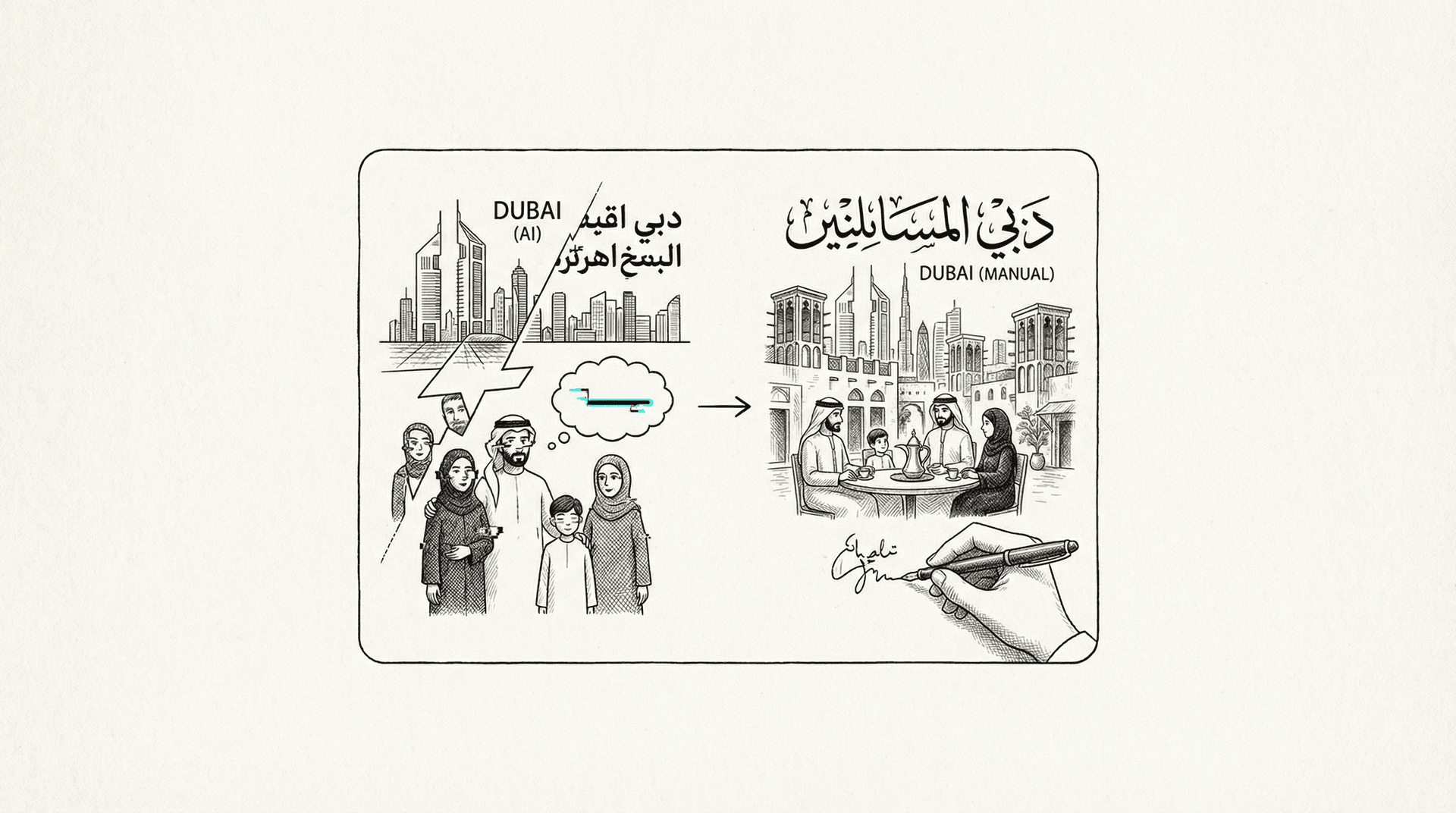
Let's start with the most obvious failure, the one that should embarrass every major AI lab: Arabic text rendering.
Midjourney V6. DALL-E 3. Stable Diffusion XL. Adobe Firefly. The brand new Flux 1.0 from Black Forest Labs, which just dropped and is impressive for image quality. Every single one of them butchers Arabic.
Here's what happens when you ask any of these models to generate an image with Arabic text:
- Letters that should connect don't. Arabic is a cursive script. Every letter has up to four forms depending on its position in a word (isolated, initial, medial, final). The models treat each letter as an isolated glyph, like generating English with spaces between every character.
- Right-to-left direction breaks. You get text that reads left-to-right, or worse, a scrambled mix of both directions. Imagine someone printing your company's tagline backwards on a billboard. That's what this looks like.
- Diacritics vanish or float away from their letters. Arabic diacritical marks (harakat) sit above or below letters and change meaning entirely. Without them, or with them misplaced, you get nonsense.
- The letterforms themselves are often wrong. Not just bad calligraphy. Actually wrong. Characters that don't exist in the Arabic alphabet. Shapes that look vaguely Arabic to someone who has never read Arabic.
For a region where Arabic calligraphy is one of the foundational art forms, where it appears on national emblems, currency, architecture, and every piece of advertising that touches a consumer, this is not a minor issue. It's a fundamental failure.
I can't use AI-generated Arabic text in client work. Period. Every piece of Arabic type has to be composited manually in post. Which means a step that should take seconds takes an hour, and the "efficiency" argument for AI tools gets a lot weaker.
The Kandura Is Not a Thobe
Here's a test. Go to Midjourney or any image generator and prompt: "Emirati businessman in traditional dress, modern office, Dubai."
What you'll get, if you're lucky enough to get something remotely correct, is a man in a white robe. But look closer.
The AI doesn't know the difference between an Emirati Kandura and a Saudi Thobe. These are not the same garment. To Western eyes they might look similar. To anyone in the Gulf, the difference is immediate and obvious.
The Emirati Kandura is collarless. It has a tarboosh, the thin tassel that hangs from the neckline. The fabric drapes a particular way. Embroidery, when present, is minimal and specific.
The Saudi Thobe typically has a buttoned collar. It's cut differently. It's longer. It may have more ornate cuffs.
Getting this wrong in an ad targeting Emiratis isn't just inaccurate. It's an insult. It's like running a campaign in Texas with imagery of the New York skyline and assuming nobody would notice because "it's all America." People notice. People care. And people lose trust in brands that can't be bothered to get the details right.
The headwear is another minefield. The Emirati Ghutra (white headscarf) is worn differently from the Saudi Shemagh (red and white checkered). The Agal (the black cord) varies in style. The way it's draped, the way it's folded. These are identity markers. AI models treat them all as interchangeable props.
I've spent more time in ComfyUI using ControlNet to fix AI-generated traditional dress than I'd like to admit. Inpainting collars off, adjusting draping, replacing headwear. Work that shouldn't be necessary if the training data included more than a handful of stock photos of "Arab man in white."
Manhattan Is Not Dubai
Prompt any current model for "luxury modern office" or "premium cityscape" and you'll get glass towers that look like they belong in midtown Manhattan or the City of London. Clean, rectangular, steel and glass.
Dubai doesn't look like that.
Dubai's architectural language is its own thing. The curves of the Burj Khalifa. The twisted geometry of the Cayan Tower. The sail of the Burj Al Arab. The blend of ultra-modern and Islamic geometric patterns. The way light hits buildings here is different because the atmosphere is different. The sand-tinged haze, the particular quality of Gulf sunlight, the way shadows fall in a desert climate.
Riyadh has its own aesthetic. Jeddah has its own. Doha, Abu Dhabi, Muscat. Each of these cities has distinct architectural DNA, and AI models flatten them all into a generic "futuristic city" that reads as Western.
For advertising, this matters enormously. When I'm generating background environments for e& campaigns, I need images that feel like the UAE. Not images that feel like a stock photo library's idea of "modern." Every environment that doesn't ring true has to be rebuilt or replaced, which defeats the purpose of using generative AI in the first place.
The Social Uncanny Valley
The problems go deeper than objects and architecture. AI models carry assumptions about how people interact that are deeply Western.
Generate a "family dinner" and you'll get a nuclear family of four around a rectangular dining table. Gulf family gatherings look nothing like this. Extended family. Different seating arrangements. Different food presentation. Different dynamics between generations.
Generate a "business meeting" and you'll get a mixed-gender group in Western business attire around a conference table. Business culture in the Gulf has its own norms, its own dress codes, its own spatial dynamics. This doesn't mean the Gulf is monolithic, but it does mean the default shouldn't be a scene from a WeWork promotional video.
Gender representation is particularly tricky. The models either default to Western casualness (which can be inappropriate for Gulf audiences) or swing to stereotypical conservatism (which is patronizing and often inaccurate). The reality is nuanced. It varies by country, by city, by context, by generation. AI has no grasp of this nuance. It has two settings: Western default and clumsy stereotype.
Religious Context: The Third Rail
I'll keep this section brief because the stakes are high and the failures are serious.
AI models have no understanding of Islamic cultural context. They don't know what constitutes appropriate or inappropriate imagery. They don't understand the significance of Quranic text (which should never appear casually in commercial imagery). They don't understand prayer contexts, mosque etiquette, or the visual language of Islamic art and its relationship to the sacred.
For anyone producing content for Gulf markets, this isn't academic. Getting religious context wrong doesn't just lose you a client. It causes genuine offense. It can go viral for the wrong reasons. It can damage a brand irreparably in a market where reputation is everything.
Every piece of content I produce goes through multiple rounds of cultural review. The AI is the starting point, not the finished product. But the starting point is so far off that the review process is more like a rebuild.
The Irony
Here's what makes all of this absurd.
The UAE has a Minister of State for Artificial Intelligence, Omar Sultan Al Olama, appointed in 2017. They were the first country in the world to create such a position. The Mohamed bin Zayed University of Artificial Intelligence (MBZUAI) in Abu Dhabi is one of the world's first graduate-level AI research universities. The Technology Innovation Institute (TII) in Abu Dhabi developed Falcon, an open-source large language model that was, for a time, the highest-ranked open-source LLM in the world.
Saudi Arabia is pouring billions into AI through NEOM, through its Vision 2030 strategy, through direct investment in AI companies.
Qatar, Bahrain, Kuwait, Oman. Every Gulf state has AI on its strategic agenda.
The most AI-forward region in the world is investing billions in a technology that can't accurately represent its own people.
That's not just ironic. It's a market failure. There is massive demand for AI tools that understand Gulf culture, and nobody is meeting it. The labs are in San Francisco and London, the training data is overwhelmingly Western, and the feedback loops that might correct this are either nonexistent or moving too slowly.
What Would Need to Change
The root cause is training data. These models learn from what they've seen, and they've seen vastly more Western imagery than Gulf imagery. More English text than Arabic text. More New York skylines than Dubai skylines. More suits than Kanduras.
Fixing this requires several things:
Diverse training data. Not just more images from the region, but curated, high-quality datasets that capture the actual diversity of Gulf life. Not stock photography stereotypes.
Regional fine-tuning. The base models need fine-tuned variants that understand Gulf-specific visual language. LoRAs (Low-Rank Adaptation models) in the Stable Diffusion ecosystem are a step in this direction, but they're a patch on a broken foundation. I've trained custom LoRAs for specific use cases, and they help. But a LoRA that makes one model render a Kandura correctly doesn't fix Arabic text, doesn't fix environmental defaults, doesn't fix social dynamics.
Arabic-native text rendering. This probably needs to be solved at the architecture level, not through prompt engineering or fine-tuning. The models need to understand Arabic as a writing system, not just as visual patterns.
Cultural consultation. Labs need people from the region on their teams, not as an afterthought diversity hire, but as core contributors shaping the training pipeline and evaluation criteria. If your benchmark for "good output" was defined entirely by people in San Francisco, your outputs will look like San Francisco.
What I Do in the Meantime
In the absence of tools that work, you build workflows around the failures.
My current process for Gulf-market content looks roughly like this:
- Generate the base image using whatever model gives me the best starting point for the specific need. Right now that's usually Midjourney V6 for photorealistic work or Flux 1.0 for certain stylistic needs, with SDXL through ComfyUI when I need more control.
- Inpaint and correct cultural details. ControlNet for pose and structure. Inpainting for dress details, headwear, environmental corrections. This is the longest step.
- Composite Arabic text manually in Adobe Photoshop or Illustrator. There is no shortcut for this. The text has to be real, properly typeset, properly placed.
- Environmental correction in Photoshop. Adjusting lighting to match Gulf conditions. Replacing backgrounds when the generated environment is too Western.
- Cultural review with the team. Multiple passes.
- Final compositing in the Adobe suite.
For video, the equation is even worse. Kling just launched. Runway Gen-3 Alpha is new. The visual quality of AI video has jumped dramatically in the last few months. But all the cultural problems from image generation carry over into video, and they're harder to fix in motion. You can inpaint a still image. Correcting a video frame by frame in DaVinci Resolve is a different proposition entirely.
This Is a Commercial Opportunity
I'm framing this as a problem because it is one. But it's also an opportunity that someone is going to seize.
The Gulf advertising market is enormous. Saudi Arabia alone is projected to exceed $5 billion in ad spend. The UAE punches far above its weight for its size. These are premium markets with premium budgets, and the brands operating in them (telecom, automotive, luxury, aviation, finance) need content at scale.
The first AI toolmaker that actually solves the Gulf cultural problem doesn't just get a niche market. They get a grateful, well-funded market with a desperate need. Every agency in Dubai, Riyadh, and Jeddah is running into the same walls I am. We're all building the same workarounds. We'd all pay for tools that actually work.
Maybe the answer comes from the Gulf itself. MBZUAI has the talent. TII has demonstrated capability with Falcon. The funding is there. The strategic will is there. What's needed is someone deciding that image and video generation models trained on and for the region are worth building.
Until then, I'll be in ComfyUI at 9 AM, inpainting collars off Kanduras and compositing Arabic text by hand. Making the tools work despite themselves.
The AI revolution is real. It's just not evenly distributed. And for the Gulf, the gap between what these tools promise and what they deliver is measured in hours of manual work every single day.
Omar Kamel is AI Team Leader for e& at Saatchi & Saatchi, Dubai.
May 27, 2024
Stability AI Is Imploding. Open Source Will Survive It.
Stability AI's collapse proves the company was never as essential as it seemed. The Stable Diffusion ecosystem, running on thousands of machines worldwide, will outlive the corporation that created it.
Jan 12, 2024
Sora Is a Demo Reel, Not a Product
OpenAI showed impressive Sora clips, but demo reels aren't products. The real questions about cost, speed, consistency, and reliability remain completely unanswered.
Dec 25, 2023
What I Actually Learned Using AI on Client Work This Year
A year shipping real AI-powered campaigns for a major telecom client reveals hard truths: AI excels at production, not ideation. Building trust, managing rapid tool evolution, and keeping data local are what separate viable workflows from hype.