March 1, 2023
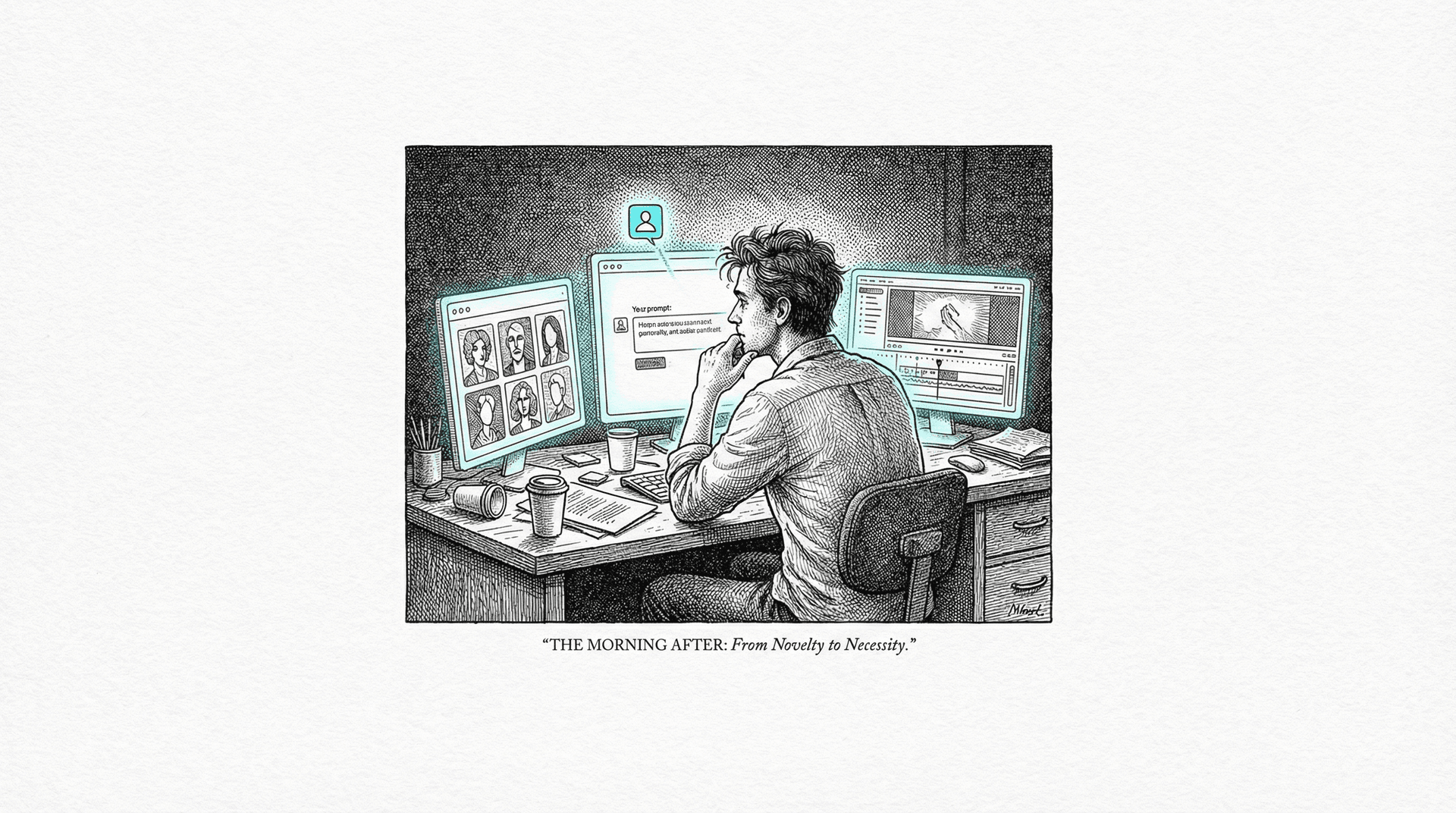
The Morning After: AI Just Got Good Enough to Matter
Something shifted this week. Here's what it actually means for people who make things for a living.
I've been making things for a living for over twenty years. TV spots, films, campaigns, content for clients across the Middle East. I've watched technologies come and go. I watched HD replace SD, watched digital kill film stock, watched social media blow up the 30-second spot format. Each time, the same pattern: panic, adjustment, new normal.
This week feels different. And I want to be careful about saying that, because every technology transition feels different when you're standing in the middle of it. But I'm going to make the case anyway, because I've been working with these tools since Stable Diffusion first released in August 2022. I was running it from day one, building workflows in Automatic1111 before most of the industry knew what a diffusion model was. I released an AI-generated music video using Deforum in September 2022. I've been deep in Midjourney since V3. I'm not a tourist here. And what landed this week changed the math.
What Happened This Week
On Tuesday, Midjourney released V5. On Tuesday, OpenAI released GPT-4. Anthropic launched Claude. Runway just shipped Gen-1. All in the same week.
Any one of these would have been worth paying attention to. Together, they feel like a threshold.
I've been in this space since the first Stable Diffusion release in August 2022. I was running it locally through Automatic1111 from the start, creating AI video with Deforum, training on custom models, and pushing these tools at real projects for months. When ChatGPT launched four months ago, the text side of the conversation exploded, but the image generation tools were still a hard sell for client work. Midjourney V4 had personality but not precision. Stable Diffusion 1.5 had control but not quality. DALL-E 2 was interesting but limited. The outputs were impressive for mood boards and personal projects (I released an AI music video using Deforum back in September) but obviously synthetic for anything a client would approve.
That just changed.
The Midjourney V5 Leap
If you haven't seen V5 outputs yet, go look. I'll wait.
The jump from V4 to V5 is not incremental. It's a category shift. V4 produced beautiful illustrations. V5 produces photographs. Not photographs in the sense of "it kind of looks like a photo if you squint." Photographs in the sense of "I showed this to a director I work with and he asked me which stock library I pulled it from."
Skin texture. Light falloff. Depth of field. The way fabric catches a shadow. V5 gets these things right in ways that V4 simply could not. It's still not perfect (hands remain a problem, text in images is a disaster, and consistency across multiple generations is basically nonexistent), but the floor just rose dramatically.
Here's why this matters for production work specifically: the concepting phase just collapsed in time. When I'm pitching visual directions for a project, I no longer need to pull from stock libraries and hope people can imagine the final execution. I can generate concept visuals that look close enough to finished photography that the conversation changes. Instead of "imagine something like this," it becomes "here, look at this."
That's not a small shift. Anyone who's ever watched a concept die in a meeting because the reference image didn't capture the vision knows exactly what I mean.
GPT-4 and the Writing Process
GPT-4 is a different kind of tool for a different part of the process. I'm not going to pretend I fully understand its implications yet, because it's been live for approximately 24 hours. But I've been testing it, and here's what I notice.
ChatGPT was useful for first drafts of things. Serviceable copy. Decent brainstorming. GPT-4 is something else. It reasons. When I give it a project concept and ask for variations on the messaging, it doesn't just remix words. It understands the tension in the idea and writes against it. When I ask it to critique its own output, it does so with something that resembles actual judgment.
For my work, the immediate application is in concepting and writing. Not as a replacement for writers (I can already hear the objection, and I agree with it), but as a brainstorming engine that operates at a speed and breadth that no individual can match. I can explore fifty tonal directions in ten minutes. Most of them will be mediocre. Some will be surprising. The job of the creative is to know the difference, and that job hasn't changed.
But I want to be honest about something: the floor of acceptable copy just rose too. A junior copywriter who produces first-draft quality that GPT-4 can match in seconds has a problem. Not because GPT-4 will replace them, but because the baseline expectation of what constitutes a useful contribution just shifted upward. If you're only bringing "competent first draft" to the table, you need to bring more.
What I've Been Doing with Stable Diffusion
While the industry conversation focuses on Midjourney and DALL-E, I've been running Stable Diffusion locally through Automatic1111 since last summer. Both the 1.5 and 2.1 models. I built AI video using Deforum for a music video last September. I've trained custom models. I've burned through more GPU hours than I'd like to admit. And this is where I think the real story lives, because local execution changes the equation in ways the cloud tools can't match.
Midjourney is a black box. You type a prompt, you get an image, and you have limited control over what happens between those two steps. For exploration and concepting, that's fine. For production, where I need reproducibility, fine control, and the ability to build workflows, it's not enough.
Stable Diffusion running locally is slower, harder to use, and produces worse results out of the box. But it gives me control. I can train models on specific visual styles or subjects. I can use ControlNet to condition generation on specific compositions, poses, and edge maps. I can build img2img pipelines that take rough sketches and translate them into polished visuals with consistent style. I can do things with Deforum and AnimateDiff that no cloud service offers.
This is the difference between a point-and-shoot camera and a darkroom. The point-and-shoot gives you a picture. The darkroom gives you a process.
Most agencies haven't noticed this yet. They're still in the "look what Midjourney can do" phase, sharing outputs on Slack and marveling at the novelty. I get it. The novelty is real. But I've been past that phase for months, and what I can tell you from the other side is that the production applications live in the local, controllable, pipeline-oriented tools. The agencies that figure this out first are going to have a meaningful advantage.
The Gap
Here's where I have to pump the brakes, because the gap between "impressive demo" and "finished deliverable" is wider than most people discussing AI seem to understand.
I've been in production for two decades. TV, film, content for the Middle East. I know what professional output looks like. It means precision. It means the product looks exactly like the product. It means the visual is on-brand. It means the colors are within spec. It means the Arabic text is grammatically correct and beautifully typeset (and right now, no image generation model handles Arabic text at all).
None of the current tools deliver this out of the box. Not one.
What they deliver is a starting point. A very good starting point, in many cases. But the distance from that starting point to a finished deliverable still requires human skill, human judgment, and human labor. Photoshop isn't going anywhere. Art directors aren't going anywhere. The person who understands composition, typography, color theory, and visual storytelling isn't going anywhere.
What's changing is the speed of the first 70%. The concepting phase. The exploration phase. The "what if we tried this" phase. That used to take days. Now it takes hours or minutes. And that compression changes the economics of production in ways I don't think anyone has fully reckoned with.
The Fear
I've had three conversations this week with creatives who are scared. Designers, illustrators, copywriters. People who make beautiful things for a living and who are watching tools appear that seem to threaten the core of what they do.
I'm not going to patronize them by saying "don't worry, AI can't replace you." That's a non-answer. Here's what I actually think.
The tool is a multiplier. If you multiply zero by ten, you still get zero. An AI image generator in the hands of someone who doesn't understand composition, lighting, color theory, or visual storytelling will produce technically competent garbage. The same tool in the hands of someone who understands these things will produce work that would have taken them a week in a fraction of the time.
If your value as a creative is in execution only (you can operate Photoshop, you can draw a straight line, you can follow a comp), then yes, you have a problem. Because execution is exactly what these tools are accelerating.
If your value is in thinking, in taste, in knowing why one visual works and another doesn't, in understanding the cultural context of a piece of communication, in bringing a perspective that no prompt can encode, then you don't have a problem. You have a power tool.
But I'll be honest about the in-between: there are a lot of people in this industry whose jobs are mostly execution with a thin layer of judgment on top. Junior designers who tweak stock photos. Copywriters who produce variations on a template. Layout artists who resize banners. These roles are going to change. I don't know exactly how, and anyone who tells you they do is selling something. But they're going to change.
What Skills Matter Now
Here's my working theory, and I reserve the right to be completely wrong about this in six months.
Prompting is a temporary skill. Right now, being good at writing prompts for Midjourney or Stable Diffusion feels like a superpower. It won't last. The interfaces will improve, the models will get better at understanding intent, and the current dark art of prompt engineering will become as mundane as knowing how to use a search engine. Don't build your career on it.
Visual literacy is permanent. Understanding why an image works. Understanding composition, light, color, tension, mood. Understanding how a visual communicates differently across cultures (something I deal with daily, producing content for audiences from Riyadh to Casablanca to Istanbul). This is what separates a useful AI output from a useless one, and no model upgrade will make this skill obsolete.
Technical pipeline thinking is increasingly valuable. The ability to chain tools together, to build workflows that are reproducible and scalable, to understand what happens between "prompt" and "deliverable." This is production thinking, and it's the same skill that made me useful in traditional post-production with Adobe suites and DaVinci Resolve. The tools change. The thinking doesn't.
Strategic and cultural judgment is irreplaceable. Knowing what to make, not just how to make it. Knowing that a visual reference that works in Dubai might be offensive in Jeddah. Knowing when to push a creative vision and when to give people exactly what they asked for. None of this is being automated. None of it will be.
Where This Goes
I don't know. And I'm suspicious of anyone who claims they do.
A year ago, image generation was a novelty. Six months ago, ChatGPT didn't exist. This week, I'm looking at tools that produce photorealistic images and write with genuine reasoning capability. The rate of change is disorienting, and extrapolating from the current trajectory feels reckless.
What I know is this: the tools just became good enough to matter for real production work. Not good enough to replace the people who do that work. Not good enough to ship without human intervention. But good enough that ignoring them is no longer a defensible position for anyone in this industry.
I'm going to keep experimenting. I'm going to keep building workflows and breaking them and building them again. I'm going to keep being honest about what works and what doesn't, because the last thing this conversation needs is more hype from people who've never had to deliver on a Tuesday deadline.
The morning after is always disorienting. The room looks different in daylight. But you still have to get up and go to work.
And the work is still the work.
Omar Kamel is an AI creative lead with two decades of experience in TV, film, and content production, based in Dubai.
Apr 21, 2026
My YouTube Editor Is a Claude Instance.
My YouTube editor is a Claude instance called Pax. It runs a six-stage pipeline, from transcription to loudness normalization, and ships finished videos without me touching the timeline, so I can spend my time on strategy instead of grind.
Apr 1, 2026
The Gap Between AI Hype and Production Reality
Between Sora's spectacular demo and its shutdown lies a story about AI's real production cost. The gap between hype and deliverables isn't just time. It's a fundamental mismatch between what demos promise and what production demands.
Mar 15, 2026
What AI Can and Can't Do in Creative Production Right Now
AI image, video, and voice tools are production-ready today, but only for practitioners who know where they deliver and where they bluff. Here's what actually works on real client projects.