August 14, 2025
Who Trains the Next Art Director?
The industry is automating the exact roles that produce its future leaders. Nobody seems to be thinking about what happens in ten years.
I learned how to be a creative by doing work that nobody wanted to do.
Hundreds of banner ads. Social posts that would be forgotten in twelve hours. Resize after resize after resize. Tagline variations that went nowhere. I sat next to people who were better than me and watched how they thought. Not how they used the software. How they thought. Why they picked this crop over that one. Why they killed a headline that I thought was clever. Why a layout that looked fine to me made them wince.
That's how it works. That's how it has always worked. You do the tedious work, you absorb the thinking behind it, and somewhere around year five or six, you start to have instincts that you couldn't have learned from any book or course or tutorial. They're instincts that only come from repetition, from failure, from sitting in the room when decisions get made.
And right now, the advertising industry is systematically eliminating the roles where that learning happens.
The Ladder Had a Purpose
Every senior creative director you admire started as someone's assistant. They started by doing the unglamorous work. The grunt work. The work that, on a spreadsheet, looks like it could be automated.
Because it can be automated. That's the problem.
A junior art director learns composition by producing hundreds of layouts. Not because those layouts are the point. The layouts are the vehicle. The learning is the point. A junior copywriter learns voice by writing thousands of social posts, most of which are forgettable. That's fine. The posts aren't the education. The act of writing them, getting feedback, rewriting them, watching which ones connect and which ones don't: that's the education.
A junior retoucher learns what makes a photograph work by spending years fixing photographs that don't work. They develop an eye for skin tone, light quality, spatial relationships, the dozen subtle things that separate an image that feels alive from one that feels dead. This knowledge doesn't come from a textbook. It comes from ten thousand hours of looking and adjusting and looking again.
These roles look like overhead on a balance sheet. They look like the obvious place to cut when you have a tool that can generate layouts, write social copy, and retouch photos at a fraction of the cost. And that's exactly what's happening across the industry right now.
The Apprenticeship Pattern
This isn't unique to advertising. Every craft-based profession works the same way.
Film directors were assistant directors first. They spent years on sets, watching how other directors blocked scenes, managed actors, made the hundred small decisions that turn a script into footage. Martin Scorsese was an editor before he was a director. The Coen Brothers cut industrial training films. David Fincher directed music videos and commercials for a decade before getting near a feature. The early work wasn't a detour. It was the foundation.
Musicians played covers in bars. They learned the structure of songs by performing other people's songs hundreds of times before they could write their own. Chefs peeled vegetables for years before they touched the menu. The boring early work builds the foundation for the interesting later work. This is not a cliché. It's a structural reality of how complex creative skills develop.
The BCG/Harvard study from 2023 found something that should be tattooed on every agency CEO's forehead: AI makes skilled workers more productive, but it doesn't make unskilled workers skilled. People who already had deep expertise used AI to amplify it. People without that foundation used AI to produce confident-looking work that fell apart under scrutiny.
This finding confirms what any experienced creative already knows intuitively. The tool is a multiplier. It multiplies whatever you bring to it. If you bring twenty years of visual judgment, you get twenty years of visual judgment operating at ten times the speed. If you bring nothing, you get nothing at impressive velocity.
The Numbers Tell the Story
The data is grim if you know where to look.
Through 2024 and into 2025, the major holding companies have been restructuring. WPP, Publicis, Omnicom, IPG: all of them are reorganizing around "efficiency." That's the word they use. What it means in practice is fewer junior roles, more AI tooling, and an expectation that senior creatives will absorb the work that used to be distributed across a team.
Freelance rates for commodity creative work have cratered. Basic illustration, simple copywriting, banner production, social content. The work that used to sustain early-career creatives while they built their skills now pays a fraction of what it did three years ago, if it's available at all. Meanwhile, rates for senior creative direction have held or increased. Clients still need people who can think. They're just less willing to pay for the people who are learning how to think.
The middle is being hollowed out. The bottom is disappearing. What remains is a bifurcated industry: a shrinking pool of expensive senior talent and an expanding set of AI tools, with very little in between.
If you're a Gartner chart person, AI in creative production is settling into the Trough of Disillusionment, the phase where the initial hype fades and people start reckoning with practical limitations. But the disillusionment isn't slowing the layoffs. Agencies already made the headcount decisions. The junior positions that were cut aren't coming back just because the AI tools turned out to be less magical than the sales pitch suggested.
The Irony
Here's the part that should keep agency leaders up at night.
The people who use AI most effectively in creative production are senior creatives. People with deep visual literacy, strong conceptual thinking, years of production experience. When I use ComfyUI to build a workflow, or direct a generation in KlingAI or RunwayML, I'm drawing on two decades of production knowledge. I know what good looks like. I know what the client needs. I know which outputs to keep and which to kill. The AI doesn't know these things. I do.
Those skills were built in junior roles. In the exact roles that the industry is now eliminating.
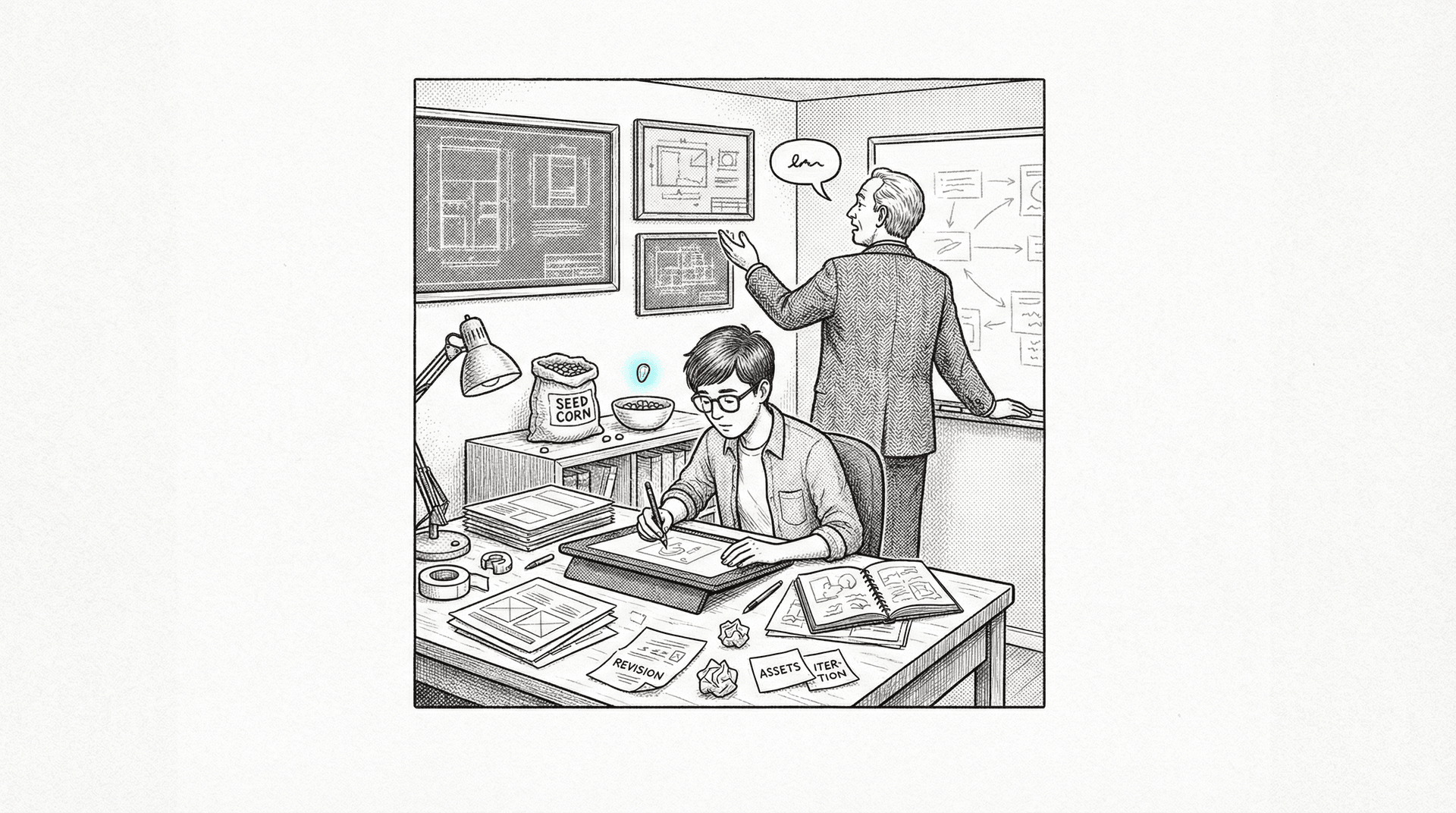
We are eating the seed corn.
This isn't a metaphor that requires explanation. You save seed corn because you need it to plant next season's crop. If you eat it because you're hungry today, you starve next year. The industry is consuming its future talent pipeline to save money right now, and the bill will come due in five to ten years when there's nobody qualified to fill senior creative positions.
Who will be the creative directors of 2035? Where will they have learned their craft? What will they have done for their first ten years that gave them the judgment and instinct that separates a creative director from someone who can operate an AI tool?
I don't have a good answer. I don't think anyone does. And that should alarm us.
What I Would Have Missed
I want to make this personal for a moment, because abstract arguments about industry pipelines can feel disconnected from the reality of how people actually develop.
My first years in this business were not glamorous. I did work that, viewed in isolation, looked like it could be automated. Layout variations. Asset resizing. Script revisions that went through seventeen rounds before the client was happy. Production coordination that involved more spreadsheets than creativity.
But that work put me in rooms where I could watch senior creatives operate. I saw how a good art director could look at a layout and immediately identify what wasn't working, not because they had a formula, but because they'd seen ten thousand layouts and their pattern recognition had been trained on all of them. I saw how a good writer could read a brief and find the tension in it, the thing that would make the work interesting instead of merely correct.
I had mentors who gave me work that seemed tedious at the time but was actually training. "Make me twenty variations of this layout" wasn't busywork. It was teaching me to see the differences between compositions, to understand why certain arrangements create tension and others create calm, to develop the muscle memory of visual decision-making.
If I had started my career with AI tools that could generate those twenty variations in seconds, would I have developed that eye? I honestly don't know. And that uncertainty is the core of the problem.
The obvious counterargument is that AI frees creatives from drudgery so they can focus on higher-level thinking. That sounds great in a conference presentation. In practice, the higher-level thinking doesn't develop in a vacuum. It develops through the drudgery. The drudgery is the curriculum.
What the Industry Should Do
I don't pretend this is simple. The economics are real. Agencies operate on margins that were thin before AI and are under even more pressure now. Telling a holding company CEO to keep headcount for developmental purposes when a tool can do the output faster and cheaper is a hard sell.
But the alternative is worse. An industry that can't produce its own senior talent is an industry that hollows itself out. And the timeline on this isn't decades. It's happening now. The juniors who should be starting their careers in 2025 are entering a market with fewer entry points, less mentorship, and an implicit message from the industry that their labor isn't worth investing in.
Here's what I think needs to happen.
Rethink what junior roles are for. Stop evaluating entry-level creative positions purely on output. A junior designer's value isn't just the banners they produce. It's the creative director they become in fifteen years. If agencies can't see that, they deserve the talent crisis that's coming.
Build new apprenticeship models. If traditional junior roles are being compressed by AI, create new structures that serve the same developmental function. Pair junior creatives with senior mentors explicitly. Create rotational programs where early-career people work across disciplines. Make the learning intentional instead of incidental.
Make AI literacy part of creative education, not a substitute for it. Creative schools should be teaching students to use AI tools. They should also be teaching composition, typography, color theory, visual storytelling, and all the foundational skills that make AI useful instead of dangerous. If a graduate can prompt an AI but can't explain why a layout works, the education failed.
Value judgment, not just output. The industry needs to recalibrate what it pays for. The most valuable thing a senior creative brings isn't the ability to produce work. It's the ability to evaluate work. To know what's good, what's almost good, and what's garbage that looks good. That judgment is the product of years of doing the work. If we don't invest in creating the conditions where that judgment develops, we won't have it when we need it.
Agencies should think of junior hiring as R&D. Not as a cost center. The money spent developing early-career creatives is an investment in the agency's future capability. Companies that understand this will have a structural advantage over those that don't. In ten years, the agencies that kept investing in human development will have senior talent. The ones that cut everything will be staffed by prompt operators who can't tell good work from bad.
The Uncomfortable Truth
I use AI every day. I believe in it as a tool. I've built production workflows around it. I've seen it compress timelines and open creative possibilities that didn't exist three years ago. I'm not a Luddite, and this isn't a Luddite argument.
This is a structural argument about how complex creative skills are developed in human beings. Those skills require time, repetition, mentorship, and the opportunity to fail in low-stakes environments before the stakes get high. The industry's current trajectory is removing all of those conditions simultaneously.
There's a version of the future where AI makes the creative industry more productive, more experimental, and more interesting. A version where the tedious parts of production are handled by tools and humans focus on the thinking that tools can't do. I want that version. I'm working toward it.
But that version requires humans who can think. And those humans don't appear fully formed. They're built, slowly, through years of practice and mentorship and unglamorous work.
The question isn't whether AI will transform creative production. It already has. The question is whether, in our rush to capture the efficiency, we're destroying the pipeline that produces the people who make the efficiency worth anything.
Every automation decision is also a training decision. Every junior role eliminated is also a future senior creative who won't exist. The industry needs to start seeing both sides of that equation, or it will wake up in 2035 wondering why there's nobody left who can tell the difference between work that's good and work that merely looks good.
The tools don't care about this. They'll keep getting better regardless.
The question is whether we will.
Omar Kamel is AI Creative & Production Lead at Optix (Publicis Groupe), Dubai.
May 19, 2025
The 80/20 Problem Nobody Talks About
AI gets you 80% of the way in 20% of the time. The last 20% takes 80% of the effort, and that's where the actual job lives.
Feb 4, 2025
Sora Shipped. It's Fine.
Sora finally shipped after a year of hype. The verdict: it's fine. That's devastating when you've spent twelve months telling people it will change everything.
Nov 14, 2024
AI Video Got Serious This Year
2024 was the year AI video crossed from novelty to production tool. Here's what actually works, what doesn't, and why Coca-Cola's Christmas ad matters.